

Canada Cosmetic Labelling Requirements 2026: Fragrance Allergen Disclosure Guide for Cosmetic Brands
Introduction
Planning to launch or import cosmetic products into Canada? Understanding Canada’s cosmetic labelling requirements is essential before finalising packaging, printing labels or distributing products in the Canadian market.
In 2026, one of the most important developments for cosmetic manufacturers, importers and private-label brands is the expanded disclosure of fragrance allergens on cosmetic labels. These requirements affect how certain fragrance ingredients must be declared, even when they form part of a fragrance mixture or botanical extract.
For businesses selling skincare products, serums, moisturisers, shampoos, body lotions and other cosmetics in Canada, these changes make ingredient transparency and label review more important than ever.
In this guide, Fiducia Globus explains Canada’s fragrance allergen disclosure requirements, the applicable transition dates, the thresholds for disclosure and the practical steps businesses should take to prepare compliant cosmetic labels.
1. What are Canada’s fragrance allergen labelling requirements?
Health Canada’s Cosmetic Regulations require certain fragrance allergens to be individually identified in a cosmetic product’s ingredient list when their concentrations exceed specified thresholds.
Previously, fragrance mixtures could generally be declared using terms such as “parfum” or “fragrance”. However, certain allergens must now be listed separately so consumers can identify ingredients that may cause allergic reactions or skin sensitivity.
The Canadian requirements incorporate the relevant fragrance allergens identified in Annex III of the European Union’s Cosmetics Regulation. This approach supports greater alignment between Canadian and European cosmetic ingredient disclosure requirements.
Importantly, the obligation to disclose a fragrance allergen applies regardless of its function in the formulation. An allergen may require declaration even when it originates from a fragrance mixture or botanical extract.
2. What changed in 2026?
Canada is implementing expanded fragrance allergen disclosure requirements in stages. The applicable date depends on whether the cosmetic is a new product or an existing product already on the market.
Implementation date
Requirement
April 12, 2026
Disclosure of the original list of 24 fragrance allergens applies to new and existing cosmetics.
August 1, 2026
New cosmetics must comply with the expanded list of 81 fragrance allergens.
August 1, 2028
Existing cosmetics must comply with the expanded fragrance allergen disclosure requirements.
These dates are particularly important for businesses planning new product launches, ordering packaging in bulk or maintaining existing products in the Canadian market.
Practical implication: As of October 2026, businesses launching new cosmetics in Canada should already be reviewing labels against the expanded fragrance allergen list. Businesses with existing products should also plan their label updates well before the August 2028 deadline.
The transition provisions should be assessed against the product’s status and applicable regulatory guidance rather than assumed to apply identically to every product.
3. Which fragrance allergens must be disclosed?
The expanded requirements cover 81 fragrance allergen entries, compared with the original list of 24.
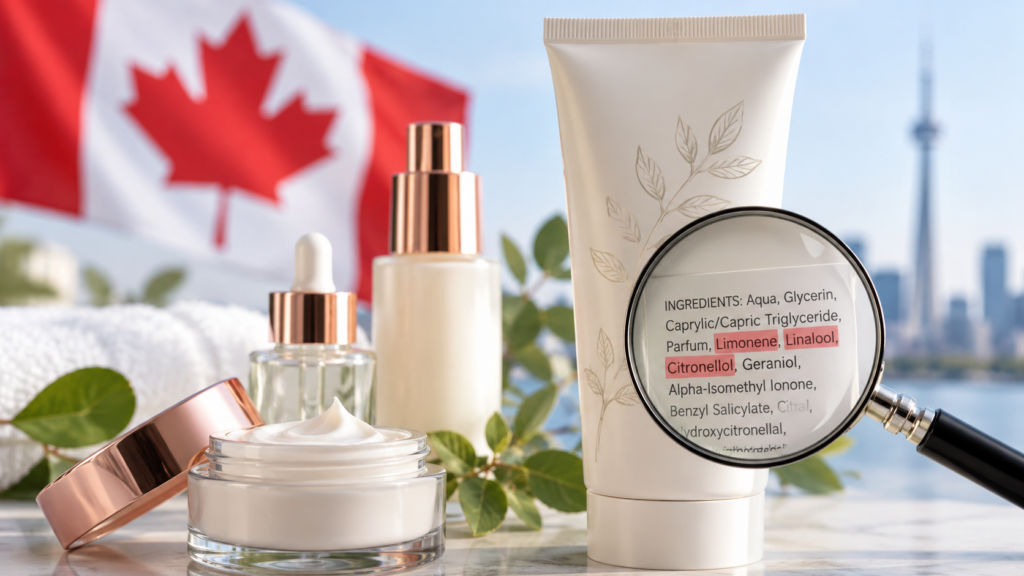
The original list includes commonly encountered fragrance ingredients such as:
Limonene
Linalool
Citral
Citronellol
Geraniol
Eugenol
Coumarin
Benzyl alcohol
Benzyl salicylate
Hexyl cinnamal
Hydroxycitronellal
Isoeugenol
This list is illustrative, not exhaustive. Businesses should consult Health Canada’s current Industry Guide for the Labelling of Cosmetics for the complete lists and the appropriate ingredient names.
An important consideration is that some entries in the expanded list represent groups of related substances. Where a grouped allergen entry applies, the relevant naming and concentration rules must be followed.
A cosmetic brand should not rely solely on the ingredient list supplied for the finished product if that list does not provide sufficient information to determine whether additional fragrance allergens require disclosure.
4. What are the fragrance allergen disclosure thresholds?
Health Canada applies different thresholds depending on whether a product is intended to remain on the skin or be rinsed off.
Product category
Disclosure threshold
Leave-on cosmetics
Greater than 0.001%
Rinse-off cosmetics
Greater than 0.01%
These thresholds apply to the relevant fragrance allergens under the applicable requirements.
Examples of leave-on products:
Facial serums
Moisturisers
Face creams
Body lotions
Leave-on hair treatments
Examples of rinse-off products:
Shampoos
Facial cleansers
Body washes
Rinse-off conditioners
For example, if a leave-on serum contains a fragrance allergen above the applicable disclosure threshold, that allergen must be identified individually in the ingredient list, even if the fragrance mixture itself is already declared as “parfum”.
For grouped allergens, the applicable rules may require the combined concentration of substances within the group to be considered.
Manufacturers and importers should therefore obtain sufficiently detailed fragrance composition information from their fragrance suppliers before approving packaging artwork.
5. Can cosmetic labels still use “parfum” or “fragrance”?
Yes. The terms “parfum” and “fragrance” can still be used to identify fragrance ingredients or mixtures where permitted.
However, they do not replace the requirement to declare individual fragrance allergens when those allergens exceed the applicable thresholds.
For example, a label may need to include both the term “parfum” and the names of applicable fragrance allergens.
This distinction is important because some businesses assume that declaring the fragrance mixture as a single ingredient automatically satisfies all ingredient disclosure obligations. That assumption can lead to incomplete ingredient lists and costly packaging corrections.
The ingredient list should be reviewed against the formulation, fragrance documentation and applicable Canadian requirements before printing.
6. How should cosmetic manufacturers and importers prepare?
Businesses should adopt a structured compliance review before producing new labels or reprinting existing packaging.
Step 1: Review the complete product formulation
Obtain the latest formulation and ingredient specifications for every cosmetic product intended for sale in Canada. Confirm that the ingredient list reflects the current formulation, including relevant fragrance components.
Step 2: Request fragrance allergen information from suppliers
Contact fragrance manufacturers or suppliers to obtain information on the applicable fragrance allergens and their concentrations in the supplied fragrance mixture. A generic fragrance specification may not contain enough detail to complete the assessment.
Step 3: Identify the applicable transition date
Determine whether the product falls under the requirements for new cosmetics or existing products. For new cosmetics, the expanded requirements have applied since August 1, 2026. Existing products must be assessed against the applicable transition provisions, including the August 1, 2028 deadline for the expanded list.
Step 4: Review the ingredient list
Check whether each relevant allergen exceeds the threshold for the product category. Confirm that required allergens are listed individually using the appropriate ingredient names and grouped allergen conventions, where applicable.
Step 5: Review the complete Canadian label
Fragrance allergen disclosure is only one part of Canadian cosmetic labelling compliance. The label should also be reviewed for other applicable requirements, including product identity; net quantity in metric units; ingredient declaration using appropriate INCI names; dealer identity and principal place of business; consumer contact information; required warnings and directions; and applicable English and French language requirements.
Step 6: Review the Cosmetic Notification Form
Where applicable, ensure the Cosmetic Notification Form (CNF) submitted to Health Canada accurately reflects the product’s ingredients and other required information. Fragrance allergens above the relevant disclosure thresholds must also be addressed in the notification. Submitting a CNF does not constitute Health Canada’s approval of a cosmetic product or confirm that the product complies with all applicable legislation.
Step 7: Approve artwork before printing
Finalise the regulatory review before approving packaging artwork for mass production. If a label needs to be revised, coordinate the changes with the manufacturer, packaging supplier and importer to avoid unnecessary printing costs, delays and potential relabelling.
7. What happens if a cosmetic label is not compliant?
Incomplete ingredient declarations can create regulatory and commercial risks for businesses selling cosmetics in Canada.
Potential consequences include:
Delays in product launches
Costs associated with reprinting labels or packaging
Additional inventory management and relabelling expenses
Regulatory follow-up or enforcement action
Disruption to distribution and retail relationships
The extent of the risk depends on the nature of the non-compliance and the circumstances of the product.
For brands importing cosmetics into Canada, reviewing label compliance before shipment can help identify problems earlier and reduce avoidable costs.
8. How can international cosmetic brands ensure compliance in Canada?
International brands should treat Canadian cosmetic label compliance as part of their market-entry strategy rather than as a final packaging check.
A label designed for the United States, European Union, India or another market may not automatically satisfy Canadian requirements. Differences in ingredient disclosure, language, product classification, dealer information and notification obligations can require market-specific changes.
A structured regulatory review should therefore consider the product formulation, intended use, claims, packaging artwork and Canadian notification requirements together.
Businesses developing new formulations or preparing for a packaging redesign should also consider future regulatory changes when planning print quantities and packaging inventory.
Conclusion
Canada’s expanded fragrance allergen labelling requirements are an important consideration for cosmetic manufacturers, importers and private-label brands in 2026.
With the expanded list applying to new cosmetics from August 1, 2026, businesses should review their fragrance documentation, ingredient declarations and packaging artwork now. Existing products should also be assessed against the applicable transition requirements ahead of August 1, 2028.
A proactive compliance review can help businesses reduce packaging rework, improve ingredient transparency and prepare for a smoother entry into the Canadian cosmetics market.
Need help with Canadian cosmetic label compliance?
Fiducia Globus supports cosmetic brands, manufacturers and importers with regulatory compliance and international market-entry requirements.
Our services include cosmetic label reviews, ingredient compliance assessments, Cosmetic Notification Form support and regulatory guidance for businesses entering the Canadian market.
Contact Fiducia Globus to discuss your Canadian cosmetic compliance requirements before finalising your labels or launching your products.
Official references
Health Canada — Cosmetic advertising, labelling and ingredients: https://www.canada.ca/en/health-canada/services/cosmetics/cosmetic-advertising-labelling-ingredients.html
Health Canada — Industry Guide for the Labelling of Cosmetics: https://www.canada.ca/en/health-canada/services/consumer-product-safety/reports-publications/industry-professionals/labelling-cosmetics.html
Health Canada — Guide for Cosmetic Notifications: https://www.canada.ca/en/health-canada/services/consumer-product-safety/cosmetics/notification-cosmetics/guide.html
Disclaimer: This article is intended for general regulatory information and should not be treated as legal advice or a substitute for a product-specific compliance assessment. Requirements should be verified against the current legislation and applicable Health Canada guidance.
Categories
Related Posts
-
Health Canada Removes Finished Product Specifications (FPS) Submission Requirement for NHP Applications: What Manufacturers Need to Know

-
Understanding the Canadian Cosmetic Ingredient Hotlist: What It Means for Your Business
-
Step-by-Step Guide to Getting an NPN in Canada (Natural Product Number Explained)
-
NNHPD GMP Updates 2026: Canada Natural Health Product Compliance Guide | Fiducia Globus

-
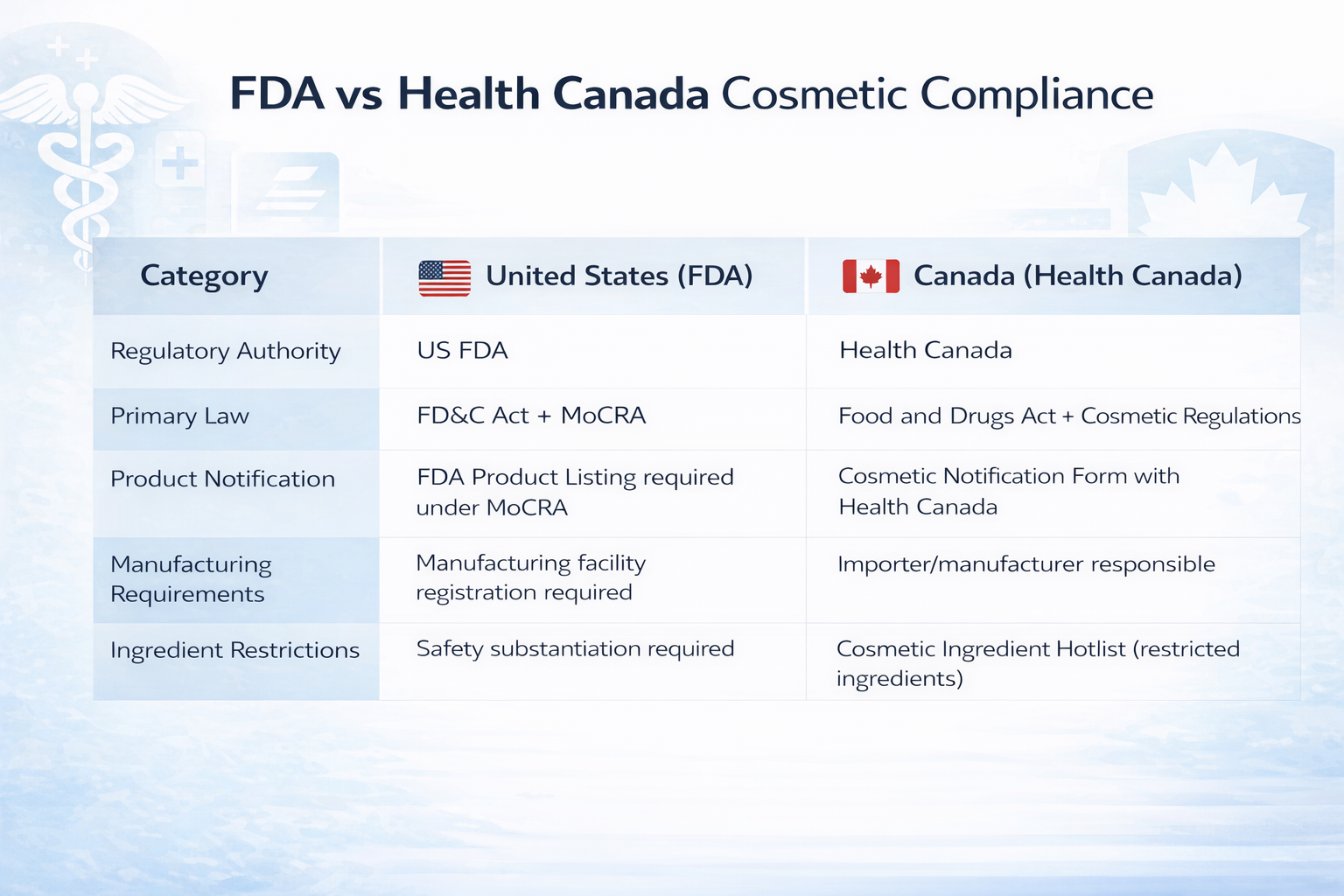
FDA vs Health Canada Cosmetic Regulations: A Technical Comparison of Compliance Requirements for Cosmetic Products